What’s the Simplest Funnel That Works?
TL;DR
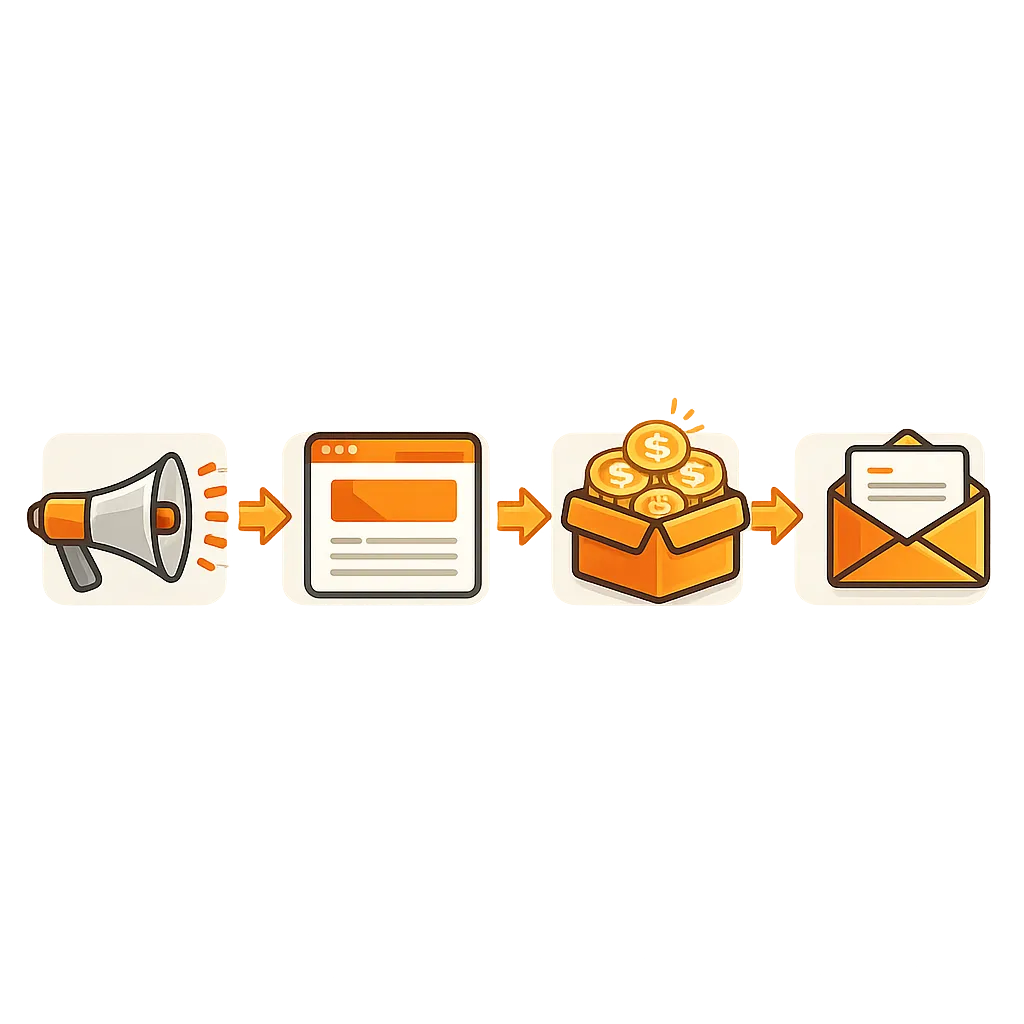
The simplest funnel that works is:
Traffic → One landing page → One offer → One follow-up sequence.
Complexity does not increase revenue.
Clarity does.
IN SHORT
A simple, effective funnel includes:
One traffic source
One focused landing page
One primary offer
One email follow-up sequence
One clear CTA
You do not need:
Multiple upsell layers
Complicated automation trees
Dozens of pages
Structure beats sophistication.
WHY THIS WORKS
Funnels fail because they are overbuilt.
Cause → Too many steps.
Effect → Friction increases.
Result → Drop-off increases.
Every extra step:
Adds confusion
Reduces momentum
Decreases conversion probability
Simplicity increases flow.
Flow increases revenue.
The 4-Step Minimal Funnel
Step 1 — Traffic
Choose one:
SEO
Paid ads
Social
Focus increases data clarity.
Scattered traffic reduces optimisation accuracy.
Step 2 — Single Landing Page
One goal.
One audience.
One promise.
No navigation.
No distractions.
Clarity precedes conversion.
Step 3 — Core Offer
Your offer must be:
Clearly positioned
Outcome-driven
Risk-reduced
Weak offers break simple funnels.
Strong offers simplify them.
Step 4 — Follow-Up Sequence
Most sales occur after first visit.
Use:
3–5 email follow-ups
Objection handling
Reinforcement of proof
Reminder of transformation
Momentum compounds through repetition.
What You Do NOT Need
You do not need:
Webinar funnels (initially)
Tripwire ladders
Multi-tier automation maps
12-step nurture paths
Those optimise.
They do not create foundation.
REAL TALK
Complex funnels are often built to compensate for weak offers.
When positioning is strong, funnels can be simple.
If you need 9 steps to convince someone, clarity may be missing.
Funnel Before Optimisation
First build:
One offer
One page
One sequence
Then optimise:
Conversion rate
Email open rate
Click-through rate
Revenue per visitor
Scale only after stability.
The Revenue Equation
Revenue = Traffic × Conversion Rate × Offer Value
Complication does not change this equation.
Clarity improves the variables.
COFFEE CUP TIP ☕
If you cannot draw your funnel on a napkin, it is too complex.
STORY TIME
A founder had:
14-page funnel
6 automation branches
3 upsells
Conversion rate: 1.6%.
We simplified to:
One landing page
One core offer
4-email sequence
Conversion increased to 3.9%.
Revenue improved.
Complexity removed.
FAQ QUICK FIX
To simplify your funnel:
1. Remove unnecessary pages
2. Focus on one offer
3. Clarify CTA
4. Add structured follow-up emails
5. Optimise before expanding
Simplicity scales.
QUICK RECAP
Simple funnels convert
Complexity increases friction
One page + one offer works
Follow-up increases revenue
Optimise before expanding
COMMON MISTAKES
Mistake: Building advanced funnels too early
Fix: Validate simple model first
Mistake: Adding upsells before core offer converts
Fix: Strengthen foundation
Mistake: Confusing automation with strategy
Fix: Clarify positioning first
FAQ
Q: Do I need a funnel builder tool?
No. Simplicity works on most platforms.
Q: Should I add upsells?
Only after the core offer converts consistently.
Q: Is email necessary?
Yes. Follow-up increases lifetime value.
Q: How long should follow-up last?
Typically 3–7 emails for initial sequence.
TRY THIS TODAY
Draw your current funnel on paper.
Remove one unnecessary step.
Test performance.
NEXT STEP
You've now seen how a simple funnel fits together.
The next step is bringing every conversion principle together into one complete strategy.
→ Conversion Strategy: Turn Traffic and Email Into Revenue
RELATED ARTICLES
→ Why Aren’t My Sales Page Converting?