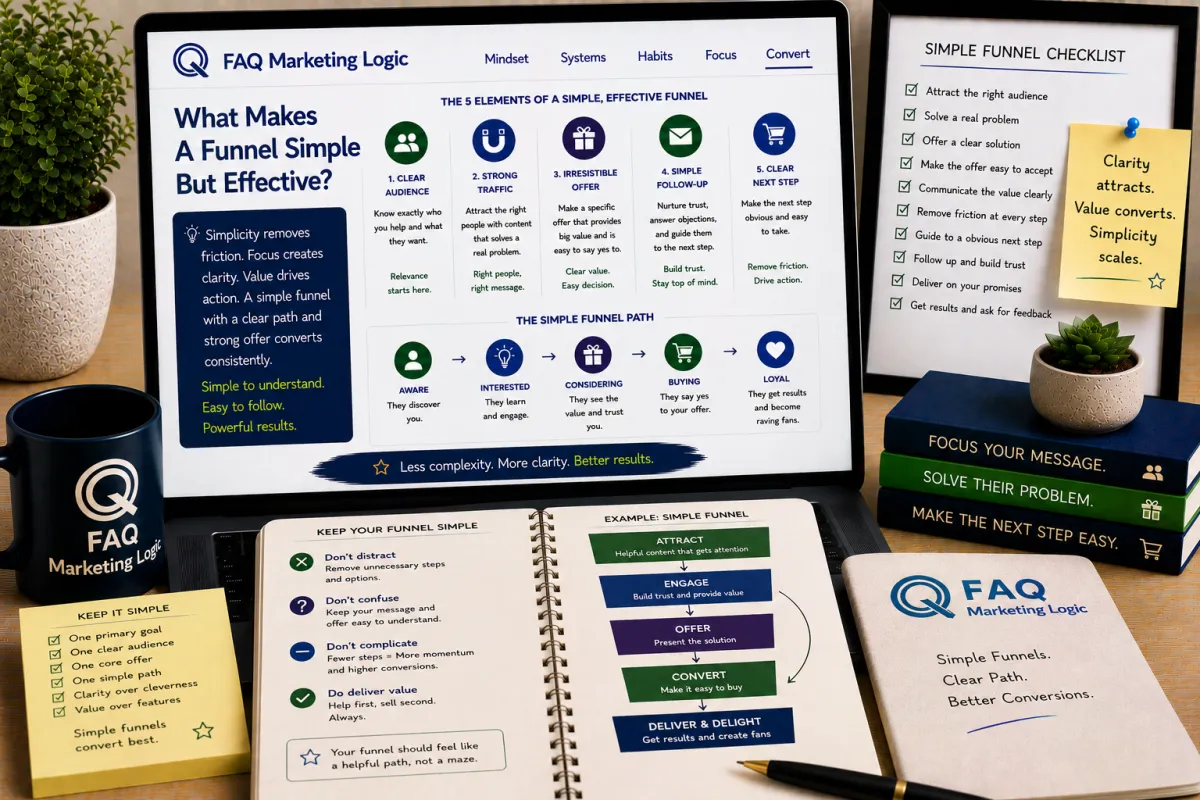
What Makes A Funnel Simple But Effective?
TL;DR
A simple funnel is effective when it guides people through a clear journey from interest to action without unnecessary complexity.
IN SHORT
Many people think funnels need:
Multiple pages
Complex automation
Dozens of emails
Advanced technology
They don't.
The best funnels often focus on clarity rather than complexity.
REAL TALK
Beginners often overbuild funnels.
They spend weeks creating:
Extra pages
Extra steps
Extra automation
Before they have proven the basics.
A simple funnel that converts is far more valuable than a complicated funnel that confuses people.
What A Funnel Actually Does
A funnel helps move someone from:
Awareness
Interest
Consideration
Action
The goal is to remove friction and help people make decisions.
Every step should have a purpose.
Keep The Journey Clear
An effective funnel usually answers:
What is this?
Why does it matter?
How does it help me?
What should I do next?
If visitors become confused, conversions often drop.
Clarity improves results.
Focus On One Goal
Many funnels fail because they ask people to do too many things.
For example:
Join a newsletter
Watch a webinar
Follow social media
Read multiple offers
Focus on one primary action.
Simple funnels convert better.
Start Small
A basic funnel might include:
A useful piece of content
A simple offer
A follow-up email
That is enough to begin testing and learning.
You can always expand later.
Common Mistake
Mistake: Adding complexity before proving the funnel works
Fix: Build the simplest version first
Optimisation is easier than overhauling complexity.
FAQ Quick Fix
To build a simple but effective funnel:
Focus on one goal
Remove unnecessary steps
Keep messaging clear
Guide visitors logically
Test before expanding
RELATED ARTICLES
QUICK RECAP
Simple funnels work because they:
Create clarity
Reduce friction
Focus attention
Encourage action
Simple often outperforms complicated.
NEXT STEP
Once you understand funnel basics, the next question is whether you need a funnel at all.
Read: