How Can Affiliate Marketing Help You Sell More Digital Products?
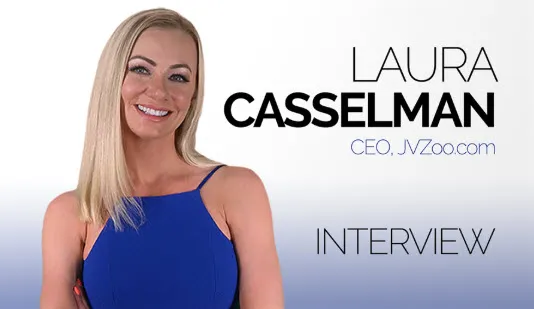
An Interview With Laura Casselman
Audio Interviews | Business & Scale
Originally recorded: August 2019
Creating a digital product is one thing. Getting that product in front of people who might actually buy it is another challenge entirely.
You can spend weeks developing a course, writing a guide or building a piece of software, only to discover that finding customers takes just as much effort as creating the product itself.
Affiliate marketing offers another approach. Instead of relying entirely on your own audience, you can work with other marketers who introduce your products to their customers in return for a commission.
In this interview from August 2019, Laura Casselman, then CEO of JVZoo, explains how affiliate partnerships work, why commissions can be a worthwhile investment and what entrepreneurs need to understand about building a sustainable online business.
The conversation also explores a subject that goes beyond affiliate marketing: knowing when to commit to an idea, when to ask for help and when to stop trying to do everything yourself.
Listen To The Interview
Guest: Laura Casselman
Role at the time: CEO, JVZoo
Recorded: August 2019
Topics: Affiliate Marketing, Digital Products, Joint Ventures, Business Growth
This interview is part of our archive of conversations with entrepreneurs and digital marketing professionals. It reflects the guest's experiences and the industry as they stood at the time of recording.
Why Affiliate Marketing Can Help Product Creators
One of the most useful points Laura makes is that affiliate marketing isn't simply about paying somebody else to sell your product. It's about reaching customers who might never have discovered your business otherwise.
That distinction matters, particularly when you're starting with a small audience.
A product creator might hesitate to offer a substantial commission because it reduces the amount received from each sale. But concentrating entirely on the commission overlooks the value of reaching new buyers through an established affiliate's audience.
Laura explains that product owners need to consider what will motivate affiliates to promote their offers. A commission that looks attractive to the seller isn't necessarily attractive to the person doing the promotion.
Of course, commissions still need to make financial sense. The aim isn't to give away as much revenue as possible, but to create an arrangement that works for both parties.
If you're still deciding what kind of product to create, our guide to choosing an online business model is a useful place to start.
Five Practical Lessons From The Interview
1. Start With A Problem Worth Solving
Laura explains that JVZoo's founders developed the platform because the software they were using didn't meet their needs.
Rather than waiting for somebody else to improve the existing solution, they created something that addressed the problem themselves.
It's a useful reminder that a business idea doesn't always need to be completely original. Sometimes the opportunity comes from identifying something people already find frustrating and providing a better solution.
Before investing months in development, it's worth checking whether other people experience the same problem and would be willing to pay to solve it.
Our article on validating an online business idea explores how to approach that decision.
2. Think Beyond Your Own Audience
Affiliate partnerships allow product creators to work with marketers who already have relationships with potential customers.
That can be particularly valuable when you're launching a new product without a substantial email list or established traffic.
However, an affiliate programme isn't a substitute for having a worthwhile offer. Partners still need a product they believe their audience will find useful, together with enough information and promotional material to explain its benefits.
The underlying lesson is straightforward: distribution deserves as much attention as product creation.
3. A Product Doesn't Have To Disappear After Launch
Laura discusses the difference between short product launches and products that remain available for ongoing promotion.
Some marketers concentrate their efforts on a limited launch period. Others continue supporting their products and allow affiliates to promote them over a longer period.
For a digital publisher, the second approach is worth considering. A useful guide, course or software product may continue serving customers long after its original launch.
That doesn't mean sales will arrive automatically. Products still need support, promotion and occasional updates. But keeping a worthwhile offer available can make better use of the work already invested in creating it.
4. Commitment Matters More Than Constantly Finding New Ideas
One of the strongest parts of the conversation comes when Laura discusses the difference between having an idea and committing to it.
Entrepreneurs often have more ideas than they can realistically develop. The difficulty is deciding which opportunity deserves their attention and then continuing when progress becomes uncomfortable.
Laura recommends making a plan, writing it down and following it consistently.
She also makes an important distinction between abandoning a goal and changing the approach used to reach it.
A plan can be adjusted when something isn't working. That doesn't necessarily mean the original objective should be discarded.
5. Stop Trying To Do Everything Yourself
Towards the end of the interview, Laura introduces an interesting idea: regularly reviewing your responsibilities and removing tasks that somebody else could perform more effectively.
She describes this as periodically firing yourself from certain jobs.
It's particularly relevant to solo business owners, who often become responsible for every part of their operation, from product development and marketing to administration and customer support.
Delegation doesn't necessarily mean hiring a full-time employee. It might involve outsourcing a specialist task, using software to simplify repetitive work or changing a process that consumes too much time.
The important question is whether your time is being spent on activities that genuinely move the business forward.
What Can You Apply To Your Own Business?
You don't need to use JVZoo or run a large affiliate programme to benefit from the ideas in this conversation.
The broader principles apply to many types of online businesses.
Start by identifying a genuine customer problem. Develop an offer that solves it, consider how you'll reach potential buyers and make sure the financial arrangement works for everyone involved.
Then look at how you're spending your time.
If you're continually creating new products but struggling to market the ones you've already finished, perhaps your next step isn't another product. It may be improving distribution, building partnerships or making your existing offer easier to sell.
And if routine tasks are preventing you from working on the business itself, consider what could be simplified, automated or delegated.
Those are decisions worth revisiting regularly, regardless of how experienced you become.
About This Interview
Laura Casselman was CEO of JVZoo when this interview was recorded in August 2019. The conversation explores the company's approach to connecting digital product creators with affiliates, alongside Laura's wider experiences in business and entrepreneurship.
Because this is an archive recording, references to platform features, processes and business results reflect the period in which the interview took place. They should not be treated as descriptions of current services or guaranteed outcomes.
Read The Full Interview Transcript
Prefer reading to listening?
The complete interview transcript is available below, including the original questions and Laura's responses.
→ Download the Full Interview Transcript (PDF)
RELATED ARTICLES
→ How Do I Choose The Right Online Business Model?
→ How Do I Validate An Online Business Idea?
→ Should I Start With Services Or Digital Products?
NEXT STEP
If this interview has encouraged you to explore digital products, start by considering what you could offer and who would benefit from it.
Our Business pillar brings together practical guides covering business models, choosing an idea, developing an offer and finding your first customers.