
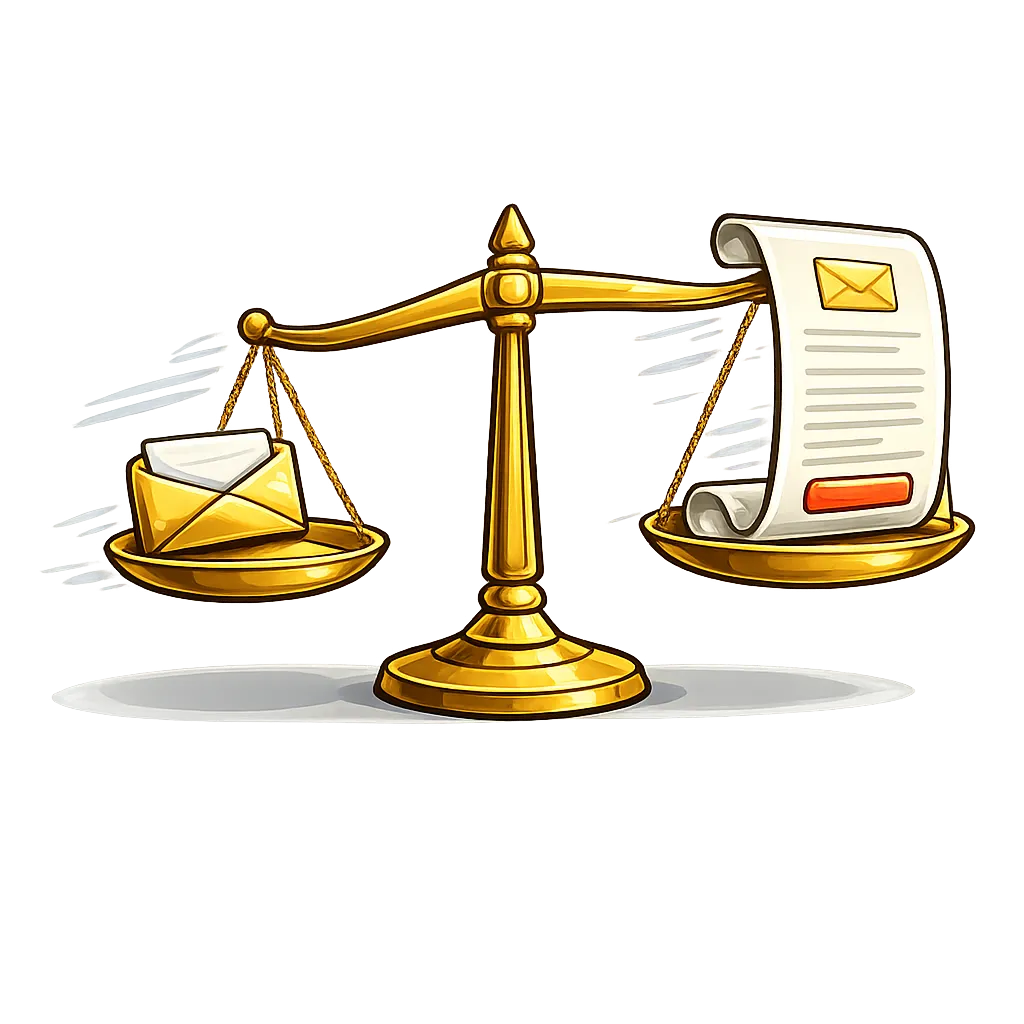
How Long Should Marketing Emails Be? (Short vs Long Explained)
TL;DR
Email length does not determine performance.
Clarity and momentum do.
Make the email as long as necessary — and no longer.
IN SHORT
The right email length:
Matches the complexity of the idea
Maintains forward momentum
Supports one clear CTA
Removes unnecessary explanation
Short is not better.
Long is not better.
Clear is better.
WHY THIS WORKS
People do not resist length.
They resist friction.
Cause → The email feels heavy, slow, repetitive.
Effect → Attention drops.
Result → No click.
A long email that flows converts better than a short one that confuses.
Length is a structural decision.
Not an aesthetic one.
When Short Emails Work Best
Short emails are effective when:
Delivering a quick insight
Driving urgency
Teasing a resource
Reinforcing a single idea
They create speed.
Speed increases action.
When Long Emails Work Best
Long emails perform when:
Selling higher-ticket offers
Teaching a nuanced idea
Handling objections
Building authority
Long emails build weight.
Weight builds trust.
But only if structured properly.
Structural Rules for Any Length
Regardless of word count:
Short paragraphs
White space
Subhead breaks
Single dominant CTA
Clear narrative arc
If it feels dense, it will not convert.
REAL TALK
Many marketers shorten emails because they fear being “too much.”
That fear reduces clarity.
If your message requires explanation, give it.
But remove filler.
Length without substance is noise.
Substance without structure is friction.
A Simple Length Test
Before sending, ask:
“Does every paragraph move the reader closer to the click?”
If not, cut it.
Precision increases performance.
COFFEE CUP TIP ☕
Delete your first paragraph.
Often it is warm-up writing.
Start where the tension begins.
STORY TIME
An ecommerce founder believed short emails convert better.
Average length: 120 words.
We tested a 650-word structured email:
Story
Problem
Objection handling
Clear CTA
Revenue per send doubled.
The difference wasn’t length.
It was clarity and structure.
FAQ QUICK FIX
If unsure about length:
1. Identify one core objective
2. Remove secondary ideas
3. Tighten sentences
4. Break long paragraphs
5. Keep one CTA
Then test across 4–6 sends.
QUICK RECAP
Length does not equal conversion
Friction reduces clicks
Short emails create speed
Long emails build authority
Structure determines performance
COMMON MISTAKES
Mistake: Cutting necessary explanation
Fix: Remove fluff, not clarity
Mistake: Writing long without structure
Fix: Use subheads and short paragraphs
Mistake: Multiple CTAs in long emails
Fix: Maintain one dominant action
FAQ
Q: What is the ideal word count?
There is none. 150–800+ words can all work depending on context.
Q: Do long emails hurt deliverability?
No, engagement matters more than length.
Q: Should I test short vs long?
Yes, but control for structure and clarity.
Q: Are long emails better for sales?
Often, especially for complex or higher-ticket offers.
TRY THIS TODAY
Take your next email draft.
Highlight every sentence that does not move the reader toward the CTA.
Delete them.
Measure clarity, not word count.
NEXT STEP
Now that structure is clear, we move into precision:
Relevance increases engagement.
Email Segmentation: When and How to Segment Your List
RELATED ARTICLES
→ How Can I Make My Emails Clearer and More Direct? (Without Sounding Harsh?)
→ How to Increase Email Engagement and Click-Through Rates
→ How to Structure Email CTAs for Higher Conversions
If you're starting a business, return to the Business pillar to strengthen your offer foundation.