
How Do I Attract The Right Visitors To My Website?
TL;DR
Attracting the right visitors to your website means reaching people who are genuinely interested in the problems your content, products or services help solve.
More traffic isn't automatically better traffic. A smaller number of relevant visitors can produce more enquiries, subscribers and customers than thousands of people who have little interest in what you're offering.
The key is to understand who you want to attract, answer the questions they're already asking and make sure your content leads naturally towards a useful next step.
IN SHORT
To attract the right website visitors, identify your ideal audience, understand what they're searching for and create content that matches their needs.
Focus on attracting people who are likely to benefit from your information or offers rather than trying to appeal to everybody.
Search engines, helpful articles, relevant communities and suitable partnerships can all bring visitors to your website. However, the quality of those visitors depends on how closely their interests match what your business provides.
The objective isn't simply to increase visitor numbers. It's to attract people who have a genuine reason to stay, explore and take action.
WHY THIS WORKS
Understand Who You're Trying To Attract
Before worrying about traffic sources, you need to understand the people you want visiting your website.
A site offering beginner-friendly digital product training needs a different audience from one selling advanced marketing software. Both might operate in the online business market, but their visitors have different problems, expectations and levels of experience.
Start by considering what your ideal visitor is trying to achieve. What questions are they asking? What problems are preventing progress? What information would help them make a decision?
You don't need an elaborate customer profile containing dozens of personal details. You need a practical understanding of the problems your website is designed to solve.
When you know who you're trying to help, choosing topics and traffic sources becomes considerably easier.
Focus On Search Intent Rather Than Traffic Volume
Not everyone searching for a particular subject wants the same thing.
Someone searching for "digital products" might be looking for a definition, examples, software recommendations or products to purchase.
Someone searching for "how to choose my first digital product idea" has a much clearer problem.
The second search may attract fewer visitors, but those visitors could be more relevant to a website that helps beginners create and sell information products.
This is why search intent matters.
Instead of choosing topics simply because they appear popular, consider what the person behind each search is trying to accomplish.
A useful article should answer that question directly and provide enough explanation to help the reader move forward.
Create Content That Solves Specific Problems
Broad subjects can be useful for introducing a topic, but specific questions often give you better opportunities to attract suitable visitors.
For example, an article about email marketing might attract people with many different interests.
An article explaining why subscribers stop opening emails addresses a more recognisable problem.
Someone experiencing that problem has a clear reason to read the article and may also be interested in related email marketing resources.
The same approach works across most business subjects.
Instead of producing general content about online business, you could answer questions about choosing a business model, validating an offer, pricing a digital product or improving a sales page.
Each article becomes a potential entry point for visitors with a particular need.
Over time, a collection of related articles can help your website become a useful resource for people interested in the subject.
Make Sure Your Content Matches Your Offers
Attracting visitors is only part of the process. You also need to consider what happens after they arrive.
Suppose your website publishes articles about starting an information publishing business.
A visitor reading about choosing a digital product idea may be interested in a beginner's guide to information publishing. They are less likely to appreciate being directed towards an unrelated product.
The closer the connection between the article and the offer, the more natural the recommendation feels.
For example, Six Figures A Year In Info Publishing introduces the information publishing business model, making it a relevant resource for visitors exploring how to turn useful knowledge into products.
The principle is simple: attract visitors with information that addresses their interests, then recommend resources that help them take an appropriate next step.
This is more useful than bringing people to your website and immediately presenting offers that have little connection with why they visited.
Choose Traffic Sources That Suit Your Audience
There are plenty of ways to attract website visitors, but that doesn't mean you should use all of them.
Search engines can be valuable when people are actively looking for answers. Relevant online communities may help you reach people discussing specific problems. Partnerships can introduce your website to an established audience with similar interests.
The right choice depends on where your potential visitors spend time and how they look for information.
For an FAQ-style website, search can be particularly suitable because individual articles are designed to answer recognisable questions.
However, search visibility takes time to develop, and publishing an article doesn't guarantee that it will rank.
The sensible approach is to select one or two suitable discovery channels, use them consistently and evaluate whether they're attracting relevant visitors.
You can expand your marketing activity once you understand what's working.
Help Visitors Find Their Next Answer
A visitor may arrive at your website through one article without knowing anything about the rest of your content.
If the article answers their immediate question, they may leave satisfied. That's not necessarily a failure, but you can make it easier for interested readers to continue exploring.
Relevant internal links help connect related questions and guide visitors towards more detailed information.
For example, someone reading about attracting suitable website visitors may also want to understand which traffic source is best for beginners or whether concentrating on one channel makes sense.
Those connections help readers discover useful information without having to return to a search engine.
Clear navigation, relevant links and a sensible next step can turn a single article visit into a more useful experience.
The important thing is to make the next action relevant rather than adding links simply to keep people on the website.
Measure Whether You're Attracting Useful Traffic
Traffic reports can tell you how many people visit your website, but visitor numbers alone don't explain whether your marketing is effective.
You also need to look at what visitors do.
Are people discovering the articles you want them to find? Are they exploring related content, clicking relevant links, subscribing or making enquiries?
If you're selling products, you may also want to understand which pages and traffic sources contribute to purchases.
Not every visitor will take action immediately. Someone may read several articles before deciding whether to subscribe or buy.
Look for patterns rather than judging individual visits.
A website attracting 200 relevant visitors who regularly explore its content may be building a more useful foundation than one receiving 2,000 visitors who have little interest in its subject.
PRACTICAL EXAMPLE
Imagine you run a website that helps beginners create and sell digital products.
You publish a general article about making money online. It attracts 1,000 visitors, but most are looking for quick income ideas rather than information about building a digital product business.
Very few explore the rest of your website.
You then publish an article answering a more specific question: "How do I know if a digital product idea is worth selling?"
That article attracts only 150 visitors.
However, those visitors are researching a problem directly connected with your business. Some read related articles, others explore your beginner resources and a few subscribe to receive further information.
The second article produces less traffic, but the visitors have a stronger connection with what your website offers.
That doesn't mean broad articles have no value. They can introduce new readers to your subject.
It means you should judge content by the relevance of the audience it attracts, not simply by the size of the visitor count.
REAL TALK
It's easy to become distracted by traffic numbers.
A sudden increase in visitors looks encouraging, particularly when you've spent months building a website and publishing content.
But traffic is only useful when it serves a purpose.
If you're attracting people who have no interest in your subject, you may be increasing your statistics without making much progress towards your business goals.
That doesn't mean every visitor needs to become a customer. Some people will only want an answer, and providing that answer is worthwhile.
However, if you're building a commercial website, you need to understand whether your content is reaching people who could eventually benefit from your products or services.
Don't chase visitor numbers at the expense of relevance.
A smaller, well-matched audience gives you something much more useful to build upon.
FAQ QUICK FIX
Want to know whether your website is attracting the right people?
Choose one of your existing articles and examine it from the visitor's point of view.
Then work through these five checks.
1. Identify the intended visitor.
Who is the article designed to help, and what problem are they trying to solve?
2. Check the search intent.
Does the article answer the question someone would reasonably expect from its title?
3. Review the content.
Does it provide practical information for the intended audience, or does it wander into unrelated subjects?
4. Examine the next step.
Are the internal links and any recommended resources relevant to the reader's original problem?
5. Look at visitor behaviour.
Are people discovering related content, clicking useful links or taking other actions that suggest genuine interest?
This exercise can help you identify whether an article needs better targeting, clearer information or a more relevant next step.
FAQ
Is More Website Traffic Always Better?
No. More traffic can create additional opportunities, but only when the visitors have some connection with your content or business. Relevant visitors are generally more useful than large numbers of people who have little interest in what you provide.
How Do I Know If My Website Visitors Are The Right Audience?
Look at the search queries and traffic sources bringing people to your website, then examine how visitors interact with your content. Relevant searches, useful link clicks, enquiries and suitable conversions can all provide evidence of audience fit.
Should I Target Popular Keywords Or Specific Questions?
Both can have a place, but specific questions are often useful because they reveal what the visitor wants to understand or accomplish. Broad keywords may attract more varied audiences and can be harder to match with a particular offer.
Can I Attract The Right Visitors Without Paid Advertising?
Yes. Search content, relevant communities, referrals and partnerships can introduce your website to suitable visitors. These methods still require effort, and results may take time to develop.
How Many Traffic Sources Should I Use?
There's no fixed number. Beginners often benefit from concentrating on one or two suitable channels before expanding. This makes it easier to understand which activities are producing relevant visitors.
Do Internal Links Help Attract Better Visitors?
Internal links don't automatically make incoming traffic more relevant, but they help visitors discover related information after arriving. They can also help search engines understand connections between pages.
TRY THIS TODAY
Open your website analytics or Google Search Console and choose one article that's receiving visitors or search impressions.
Look at the questions and search terms associated with that page.
Ask yourself:
Are these searches relevant to the article?
Do they reflect problems my website is designed to solve?
Does the article answer the visitor's likely question?
Are there related questions I could address?
Does the article link to useful supporting content?
Is the recommended next step relevant?
Would someone interested in this article have a reason to explore more of my website?
Choose one improvement you can make today.
That might mean clarifying the opening answer, improving an internal link or adding a more relevant next step.
You don't need to rebuild the entire website to improve the quality of the visitors it attracts.
Sometimes a better match between one article and its intended reader is a useful place to begin.
Want To Explore Information Publishing Further?
Attracting the right visitors becomes easier when you understand the type of business you're building and the problems your products are intended to solve.
If you're exploring the idea of creating a business around useful information, Six Figures A Year In Info Publishing introduces the information publishing model and how it can be developed into an online business.
It's a useful starting point for understanding what you're building before trying to attract more visitors.
→ Discover Six Figures A Year In Info Publishing
The physical book is offered free, with a shipping and handling charge.
RELATED ARTICLES
→ What Is The Best Traffic Source For Beginners?
→ Should I Focus On One Traffic Source Or Many?
→ What Content Gets Discovered Most Easily?
QUICK RECAP
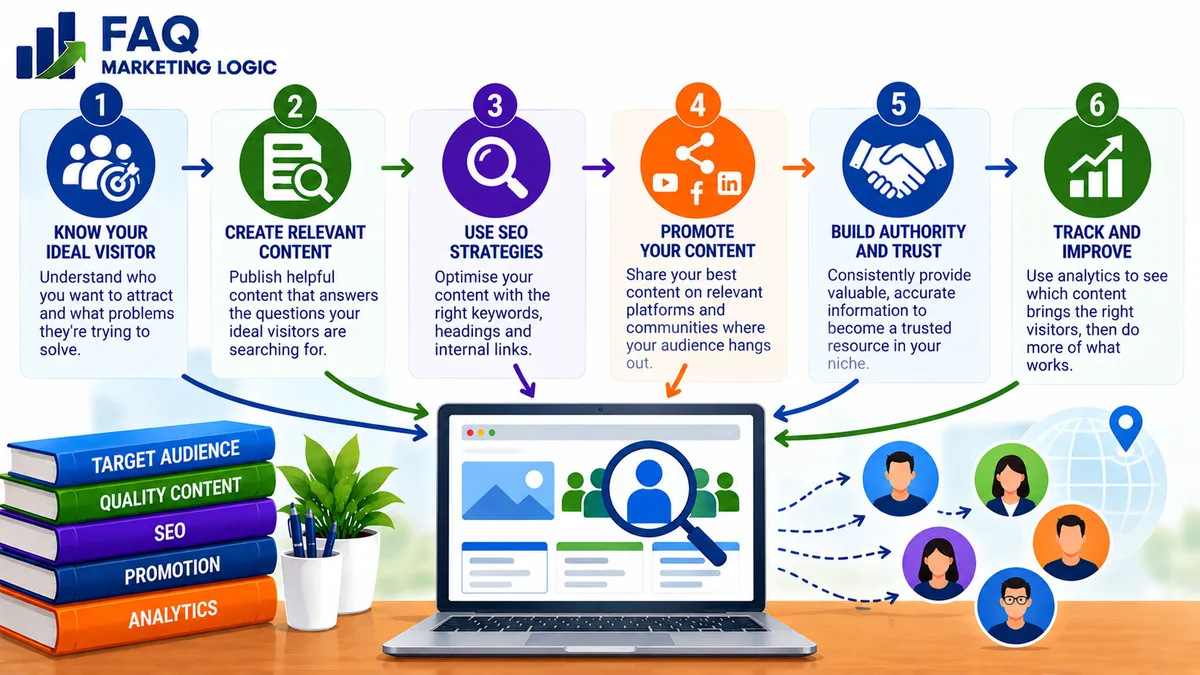
Attracting the right visitors starts with understanding who your website is designed to help.
Identify the problems your intended audience wants to solve.
Choose topics that match genuine search intent.
Answer specific questions clearly.
Create content connected with your business and offers.
Concentrate on suitable traffic sources.
Use relevant internal links to help visitors explore.
Make the next step useful rather than forced.
Measure visitor relevance, not just traffic volume.
Improve pages based on what you learn.
More visitors can be useful, but attracting the right people gives your website a stronger foundation.
The aim isn't to reach everybody. It's to become useful to the people you're trying to serve.
NEXT STEP
Once you understand which visitors you want to attract, the next challenge is choosing the most practical way to reach them consistently.